
By John J. Dougherty, DFP Foundation Products, LLC
 The
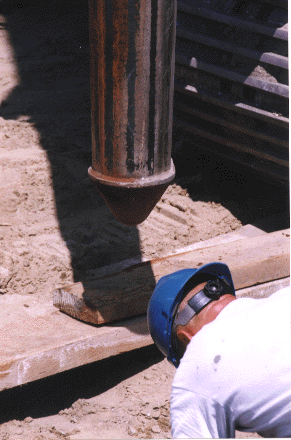
advantages of a tapered shape for a pile have been known for many years.
Some soil conditions that would otherwise not carry much load using a straight-sided
pile will carry a substantially higher load when the pile is tapered.
The combination of bearing and frictional resistance produced by the wedge
shape of the taper is greater than the side friction and end bearing of
a cylindrical pile.
The
advantages of a tapered shape for a pile have been known for many years.
Some soil conditions that would otherwise not carry much load using a straight-sided
pile will carry a substantially higher load when the pile is tapered.
The combination of bearing and frictional resistance produced by the wedge
shape of the taper is greater than the side friction and end bearing of
a cylindrical pile.
Timber piles were the first tapered piles. Perhaps the designer
of the tree engineered the shape of the trunk with piles in mind.
Using the trunk as a pile must have come easily to ancient pile drivers;
placing the small end down was obviously a better way to drive a tree trunk
into the ground.
 The
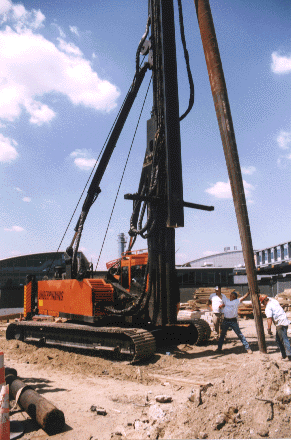
TAPERTUBE is extended to the required project length using standard size
steel pipe. The end of the TAPERTUBE that is to be spliced to the
pipe is rounded to match the diameter of the pipe. This important
step in the process, allows a smooth full strength joint that does not
break the friction between the pile and the soil. The splicing would
usually be done off site before the piles are shipped to the jobsite in
lengths up to eighty feet (80’). If additional lengths must be added
at the job, a product such as the DFP S-1800 drive fit splice or a field
butt weld can be used.
The
TAPERTUBE is extended to the required project length using standard size
steel pipe. The end of the TAPERTUBE that is to be spliced to the
pipe is rounded to match the diameter of the pipe. This important
step in the process, allows a smooth full strength joint that does not
break the friction between the pile and the soil. The splicing would
usually be done off site before the piles are shipped to the jobsite in
lengths up to eighty feet (80’). If additional lengths must be added
at the job, a product such as the DFP S-1800 drive fit splice or a field
butt weld can be used.The Port Authority of New York and New Jersey reviews all work to be done at JFK. They have approved the TAPERTUBE pile for use. They have stated in a letter, “We have reviewed the performance of the TAPERTUBE piling driven for JFK-LRS (light rail system) pile test program and the production and test piles driven for the British Airways Project. The piling performed exceptionally well during both pile driving and load testing and meets our requirements for tapered pile applications. We will be including the TAPERTUBE pile as an acceptable alternative on our future projects and will accept them for tenant projects as well.”
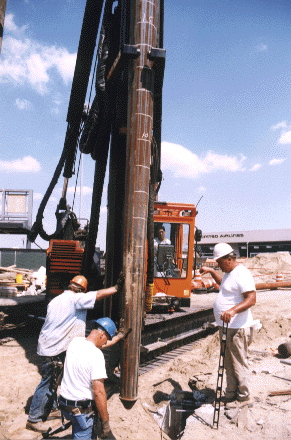
Tapertube ready for installation
 Engineers
today, are striving to increase pile loads in order to reduce the number
of piles used. Until the development of the TAPERTUBE pile, this
was difficult for tapered friction piles. The alternative tapered
pile, although fluted to add some stiffness, is manufactured in gage thickness
only with the heaviest metal being three- gage (3) or (0.239”). The
TAPERTUBE, depending on tip size, can be made in wall thickness up to one-half
inch (0.500”).
Engineers
today, are striving to increase pile loads in order to reduce the number
of piles used. Until the development of the TAPERTUBE pile, this
was difficult for tapered friction piles. The alternative tapered
pile, although fluted to add some stiffness, is manufactured in gage thickness
only with the heaviest metal being three- gage (3) or (0.239”). The
TAPERTUBE, depending on tip size, can be made in wall thickness up to one-half
inch (0.500”).Listed below are results of TAPERTUBE pile compression, lateral and uplift tests performed to date at JFK Airport. TAPERTUBE piles being driven at JFK have a tapered lower section that is twenty-five (25’) feet long which is fabricated using 0.312-inch thick steel plate (50ksi yield). The twelve-sided (12) cross-section is eight- inch (8”) diameter at the bottom and eighteen-inch (18”) diameter at the top. A length of eighteen-inch (18”) diameter 0.375” wall, ASTM A-252 grade 3 pipe (45 ksi yield), is fully butt-welded to the rounded top of the TAPERTUBE. After installation the pile is filled with five ksi (5) concrete.
 The
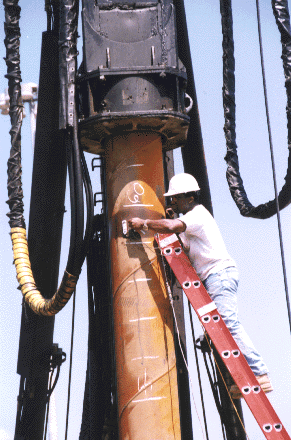
piles are being driven with a Junttan HHK-7 hydraulic hammer with a 15000-
pound ram and a delivered energy (per PDA measurements) of about 45000
ft.-lbs. Final driving resistance for pile design capacities ranging
from one hundred-twenty (120) tons to one hundred-eighty (180) tons have
been reduced to seventeen (17) to twenty-five (25) blows per foot after
the initial compression load tests, driven to higher resistances, indicated
that the requisite capacities would be achieved at lower driving resistances.
Load tests are started no sooner than twenty-one (21) days after driving
and generally show increases in ultimate compressive capacity of twenty-five
(25) percent or more over the PDA measurements made at the time of driving.
The soil profiles for the various sites at JFK are relatively uniform,
and consist typically of five (5’) to fifteen (15’) feet of sand fill,
zero (0’) to five feet (5’) of peat or organic silt, and underlain by medium
to fine sand having “N” values typically ranging from ten (10) to thirty
(30) blows per foot to depths of one hundred feet (100’) and more.
The water table is generally at a depth of ten (10’) to fifteen (15’) feet.
Potential liquefaction due to seismic considerations has mandated minimum
pile lengths of about forty-five feet (45’).
The
piles are being driven with a Junttan HHK-7 hydraulic hammer with a 15000-
pound ram and a delivered energy (per PDA measurements) of about 45000
ft.-lbs. Final driving resistance for pile design capacities ranging
from one hundred-twenty (120) tons to one hundred-eighty (180) tons have
been reduced to seventeen (17) to twenty-five (25) blows per foot after
the initial compression load tests, driven to higher resistances, indicated
that the requisite capacities would be achieved at lower driving resistances.
Load tests are started no sooner than twenty-one (21) days after driving
and generally show increases in ultimate compressive capacity of twenty-five
(25) percent or more over the PDA measurements made at the time of driving.
The soil profiles for the various sites at JFK are relatively uniform,
and consist typically of five (5’) to fifteen (15’) feet of sand fill,
zero (0’) to five feet (5’) of peat or organic silt, and underlain by medium
to fine sand having “N” values typically ranging from ten (10) to thirty
(30) blows per foot to depths of one hundred feet (100’) and more.
The water table is generally at a depth of ten (10’) to fifteen (15’) feet.
Potential liquefaction due to seismic considerations has mandated minimum
pile lengths of about forty-five feet (45’).A
summary of some of the load tests are shown below:
COMPRESSION TESTS
|
|
|
|
|
(TONS) |
CAP (TONS) |
|
|
|
|
|
|
|
|
|
|
|
|
|
|
|
|
|
|
|
|
|
|
|
|
|
|
|
|
|
|
|
|
|
|
|
|
|
|
|
|
|
|
|
|
|
|
|
|
|
|
|
|
|
|
|
|
|
LATERAL TESTS
|
|
|
|
|
|
|
|
|
|
|
|
|
|
|
|
|
|
|
|
|
|
|
|
|
|
|
|
UPLIFT TESTS
|
|
|
|
|
|
|
|
|
|
|
|
|
|
|
|
|
|
|
|
|
|
|
|
|
|
|
|
|
|
|
|
|
|
|
|
|
|
|
|
|
|
DFI
members participating in this work are Stan Merjan of Underpinning and
Foundation Constructors, Inc., George Tamaro and Joel Moskowitz of Mueser
Rutledge Consultants, Skyline Steel, and Jack Dougherty of DFP Sales, Slattery
Associates, GZA-Raamot Associates, and Mel Esrig, Consultant.
More information about TAPERTUBE is available by calling John Dougherty at 201-337-5748, or email john@tapertube.com if you prefer.
© Copyright 2001 - 2023 Pileline Publishing

